Enskedefältet - One of the Birthplaces of Swedish Hot Rodding
.JPG)

Contents
Hot Rodding Comes to Sweden
The hot rod and custom car culture reached Sweden in the early 1950s, inspired primarily by American car magazines and films that showcased modified vehicles built for speed, performance, and personal expression. These publications introduced Swedish enthusiasts to a new automotive philosophy and quickly sparked local experimentation.
As interest grew, informal meeting places and workshops began to emerge where young people could exchange ideas, share tools, and collaborate on builds. One early hub was located on Alvägen in Sollentuna, where Erik Djurberg ran a Ford workshop. His son Lennart grew up building a 1932 Ford Roadster back in 1955. Another important gathering point was the Bellander brothers' workshop in Betsede, Gustavsberg, where the young people of Nacka/Värmdö were located.
In central Stockholm, Café Cupido, commonly known as "Cupan", on Roslagsgatan became a popular meeting place for boys from both the northern and southern suburbs. One of these boys was Bosse "Gamen" Sandberg, who had his club "The Road Devils". Despite sharing similar interests, the gangs had little contact with each other at this time.
The Young Guys in Enskede
This article focuses on Enskedefältet, a residential area in southern Stockholm that became one of the most influential grassroots centers of Swedish hot rodding. The neighborhood consisted largely of self-built single-family houses on leased land, families who had relocated from Stockholm's inner city. At Österbottenvägen 10, Stig Broberg lived with his wife Viola and their son Hans. Hans and his classmate Kjell Gustad, who lived on Stralsundsgatan, began working on mopeds, motorcycles, and eventually cars on the property. The house gradually evolved into an informal youth workshop and social hub. Word spread quickly, and by the late 1950s, the gang consisted of Arne Lindstrand, Lasse "Junken", "Lill-Pelle" Karsson, "Lill-Hasse" Källberg, Bengt Wennergren from Bägerstavägen, and others.
Remarkably, relations with the neighbors were generally positive, and no major complaints came from them, even if the rampage on the local streets was sometimes wild! Kjelle Gustad remembered that they had a good hiding place behind a hedge where they could go to get away from pursuing police officers. Stig Broberg supported the activities and photographed and documented the kids with a Super-8 camera, creating a valuable historical record.
Early Car Projects
One of the first projects was a 1937 Ford Tudor coin-back that was taken apart and rebuilt on the driveway in 1957, before any of the builders had a driver's license. What happened to the car is unclear, but reportedly, the roof was cut off before it was sold. By 1959, several members had obtained their driver’s licenses, allowing the cars to be driven legally.
Cars and parts were sourced from across Sweden and Denmark, and projects followed one another in rapid succession. Activity in the basement garage was intense, with gas welding, grinding, and drills running hot while Viola served sandwiches and refreshments. At the time, scrapyards were rare, and derelict cars were driven out into the woods where they were left to decay. One early build was a 1938 Chevrolet Convertible, which underwent a thorough renovation and was equipped with an Oldsmobile Rocket V8 engine. The car received a flame paint job by Bosse "Gamen" Sandberg in his newly established garage on Flensvägen. The flames were striped by his girlfriend Karin "Morris".
Unfortunately, the boys collided with a deer, so the grill had to be redone. The car was driven year-round on long, wild road trips until it was sold in 1965. A 1957 DeSoto was mildly customized with a radical tube grille. The stock grill was given to Bosse "Gamen", who installed it on his Panel Rake Mercury, probably as a compensation for the paint job he did on the DeSoto.
- Photos from the Broberg Collection.
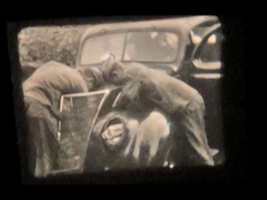
A still from the Super-8 film showing the boys working on the 1937 Ford Tudor.
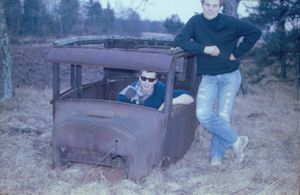
Treasure from the woods. Maybe this is Lill-Pelle's project?
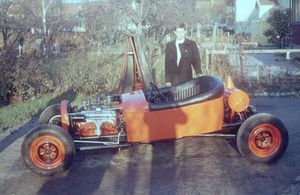
A proud Pelle with his finished T.
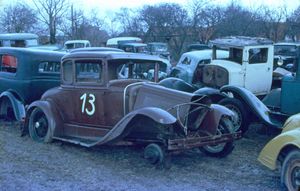
A photo from one of the junkyards in Denmark.
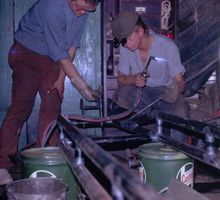
Kjelle directing where Hasse should weld.
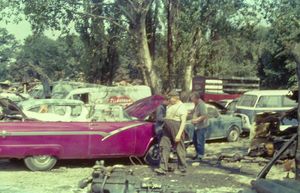
A photo of Sven Sandberg's FoMoCo in Denmark.
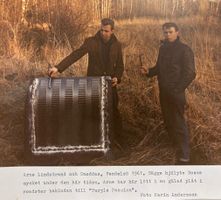
Arne Lindstrand and "Snoddas" showing the rear plate for Gamen's Purple Passion in 1961.
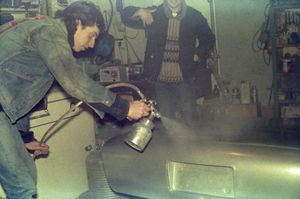
Gamen laying down a silver base on Sillarna's 1957 DeSoto. Notice the comprehensive protective equipment!
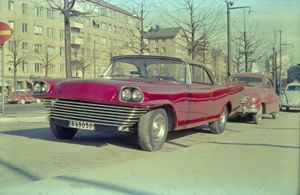
Sillarna's DeSoto parked at Ringvägen in Stockholm in 1965.
.png)
.JPG)
.jpg)
.JPG)
.JPG)
.JPG)
.jpg)
.JPG)
.JPG)
Sweden's First Dragster
In 1961, the people of Sweden were introduced to drag racing when the American-built Moon Dragster toured the country. Built on a Dragmaster kit chassis and equipped with a CSB and Potvin supercharger, the dragster had been run at 8.97 ET on the strip but was now on tour, owned and sponsored by Revell andWentzels Hobby. The Kasby brothers were involved in exhibiting the car at the NK department store in Stockholm, which was a success. Hasse and Kjelle were deeply impressed and hurried home to build a dragster of their own.
Using whatever steel tubing could be sourced, intensive welding and tinkering began in Enskedefältet. A Ford Flathead V8 was initially installed, but was later replaced by an Oldsmobile engine. The dragster was displayed in unfinished form at the “Sportvagnen & Vi” exhibition in Marmorhallarna in 1963, alongside British dragsters. After this, the car was disassembled and the chassis and engine painted red. The dragster was prepared, and the first test drives were made on the roads within the Enskede field and around Vårflodsparken. Strangely enough, the neighbors didn't call the police; one must assume that they were quite hardened by now.
Sweden's first dragster received a lot of attention in the motor press, and Gunnar Friberg from Teknikens Värld made a big report in 1965 where Gunnar himself drove the dragster at an airfield in Norrköping to establish Swedish records for elapsed time and top speed. The dragster was later sold, without an engine, to Bosse "Gamen", who repainted it and installed a Buick Nailhead engine. The engine came from Junken's 1932 Ford roadster and was tuned to just over 400 horsepower. It was exhibited at the Hot Rod Show and was run in 1966 at an unofficial drag race outside Stockholm, on the unfinished Enköpingsvägen. According to information, the dragster was dismantled into parts in the Hot Rod barn in Huddinge in 1968 when the first drag race in Anderstorp was held. What happened next is unfortunately not known.
- From the Broberg collection.
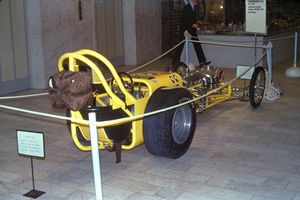
The famous Mooneyes Dragster on display at Nordiska Kompaniet in Stockholm in 1961.
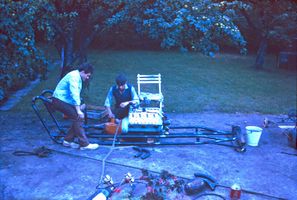
The frame for Hasse and Kjelle's dragster is ready. First try with a flattie engine, however...
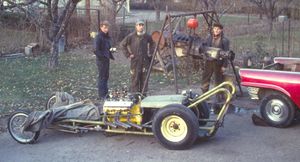
... the flathead was replaced by an Olds Rocket engine.
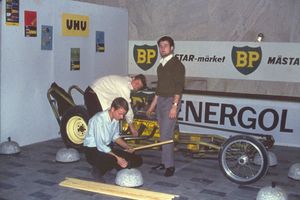
The guys properly dressed for the "Sportvagnen och Vi" exhibition in Marmorhallarna in Stockholm.
.JPG)
.JPG)
.JPG)
.JPG)
The Herrings (Sillarna)
During the early 1960s, the Enskedefältet property saw a constant flow of cars and visitors, often overcrowding the street. Evenings were spent cruising Södertörn, while weekends included visits to Henry’s Café or Talludden for dancing, socializing, and looking for girls.
Bosse "Gamen" Sandberg had the opinion that the cars should have names and that the boys should form a club like his own "|Road Devils" with cool stickers and plaques. The guys from Enskedefältet thought Gamen was pretty annoying, but okay, one evening they were sitting and brainstorming, someone came up with the name "Sillarna", which was the most stupid thing you could find. To appease "Gamen", ugly signs were made from old wooden floor tiles. Sweaters were made with the text "Herring Rodders" which were worn with a tanner. For some reason, the name "Sillarna" stuck with everyone, and even today there are stories about them and their adventures (really just Hasse and Kjelle)!
- From the Broberg collection.
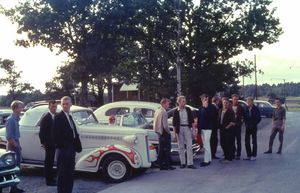
All dressed up looking for girls.
.jpg)
.jpg)
Everyone Helps Everyone, and the Gang is Growing
The early hot rodders and customizers in Stockholm frequently visited other garages to help with builds and gain inspiration. Notable projects included Palle's Chevrolet bucket with a large Chrysler engine, and Göran Silfors' 1936 Ford Tudor that received an advanced flame paint job in several colors. Because of his surname, Göran was nicknamed "Lill-Sillen."
The Sandberg family had a summer house in Gudö, Vendelsö, where the Sandberg brothers worked in an uninsulated barn. There, Sven Sandberg built his "Glowing Coupe" and Bosse his "Purple Passion," with a lot of assistance from Arne Lindstrand. The car was later completed in Bosse's garage on Flensvägen, and both were shown at the first Hot Rod Show in Marmorhallarna in the spring of 1965.
Most of the guys in the gang did not have such good opportunities for garage space with mechanic possibilities, so in 1964, the Hot Rod barn in Högmora could be inaugurated, providing shared space for many builders. In addition to the 1938 Chevarolet, Hasse and Kjelle built more cars, including a 1957 DeSoto that was customized and painted in a dark red pearl by Gamen.
"Lill-Pelle" Karlsson was 8 years younger, but one of the biggest admirers. He became aware of an old T-Ford abandoned in the woods. So with a flatbed moped, parts were picked up piece by piece and collected at Broberg's property. The roof was cut off, and the body was welded together into an open roadster. A Chevrolet engine ended up in the car, and without money, but with a lot of help, Pelle finally got together what was probably Sweden's first T-threat! However, Pelle had a long way to go to get his driver's license, so Sillarna had to take over the car and drove it a little on the Skarpnäck field. What happened to the car later is unclear. Pelle also built one of Sweden's first Trikes and started the Trike factory in the barn together with Anders Lake.
Håkan Lindell, who had lived with his mother in Ventura, California, moved back to Sweden in 1964, next door to the Broberg family. Håkan quickly joined the gang and helped with all sorts of things. He bought a 1953 Studebaker which was rebuilt. Together with his wife, Eva, cars were brought home from the United States, and various companies were started, including a car brokerage between Sweden and the United States. Later, Håkan ("Swede") and Eva moved back to the United States, ran a limousine company, and have collected lots of nice cars.
- From the Broberg collection.
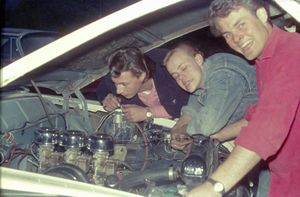
Bengt Wennergren, Göran Silfors and Kjelle under the hood.
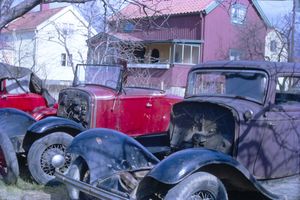
Two of the cars that were brought home. The 3-Window Coupe was chopped and later sold to Jan Serrander.
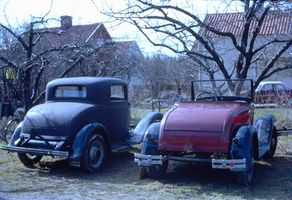
Another photo of the old Fords.
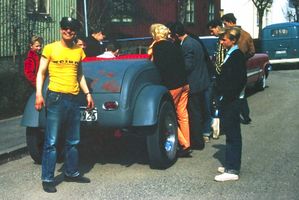
Lasse "Junken" stopping by with his 1932 Roadster in an early version before paint.
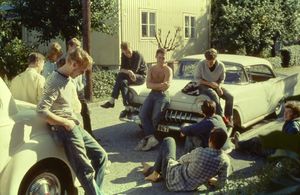
Enskedefältet was a gathering place for all the youngsters.
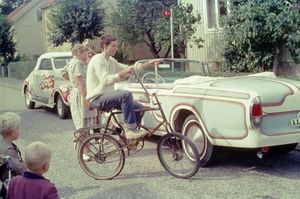
Bosse "Gamen" impresses kids with bicycling circus skills!
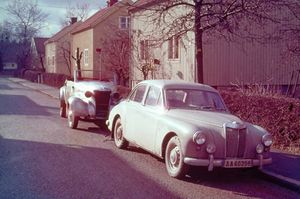
The Simca, owned by Hasse Brobergs father, Stig, was often used as a towing car.
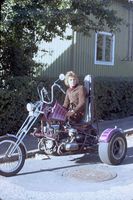
A VW based Trike by Pelle Karlsson.
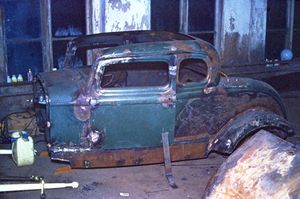
The Glowing Coupe by Sven Sandberg coming together in the barn in Vendelsö.
.JPG)
.JPG)
.JPG)
.JPG)
.jpg)
.jpg)
.jpg)
.JPG)
.JPG)
Tougher Times
Increased regulation, mandatory vehicle inspections, and stricter enforcement made modified cars harder to operate legally. Many vehicles were given the "Spanish flag" (Driving bans), and extensive documentation was required for non-standard modifications. Having the correct papers and registration certificates became important.
The Enskedefältet pioneers clearly distanced themselves from the rowdy “raggar” culture that became associated with street violence in central Stockholm as the raggars were messing around and fighting on Kungsgatan. The early hot rodders and customizers firmly distanced themselves from the drunkenness and mischief in the city. Even Bosse "Gamen", who had been the leader of |Road Devils) emphasized that hot rodding was a form of craftsmanship and cultural expression.
Pride of the Ocean
Because of the ongoing situation, some of the guys got bored with cars, and turned their attention to boats. On the sea, there were no rules! Some brought home flat-bottomed Ski-boats from the USA, which, with a V8 in the rear, became a rocket on the water! Lasse "Junken" Ljungqvist was one of the first, and several followed.
Around 1965, Sillarna, together with Arne Lindstrand, became co-owners of an old fishing cutter. The boat was at Söder Mälarstrand, and after a great deal of work they began to make it seaworthy. The hull in the bow was raised, new masts were made, and a completely new deck was built. There was no money as usual, so the project took time, but the boys were able to go away in 1969.
From the web:
1962 sold to Sven Ulrik Lindberg in Stockholm with Visby as his home port. The 65 hp 1-cyl Skandia engine was still in place at the time, but was replaced on 25 October 1965 with a 135 hp engine. In 1967 it was converted into a leisure vessel with owners in Stockholm, a part-shipping company with Sven Arne Lindstrand as main owner and with Arne Valdemar Saxin, Hans Erik Broberg and Kjell Sigvard Gustad as other partners. Then he also regained the name Pride of the Ocean. After a long period of equipment, Pride of the Ocean sailed in July 1969 to the Mediterranean Sea and from there continued its journey to the Caribbean and the Bahamas a few months later. Thereafter, sailed in the waters of the Bahamas from the beginning of 1970. On June 25, 1970, the cutter in Florida was sold through American Sailboat Brokers in Fort Lauderdale to Mrs. Martine Dupas and others in Guadeloupe. Kept the Swedish flag and Stockholm as his hometown. Ran aground on January 28, 1971 at Samana Cay in the Bahamas, All on board saved themselves ashore but the ship sank. After a week on the deserted island, the crew and passengers were rescued.[1]
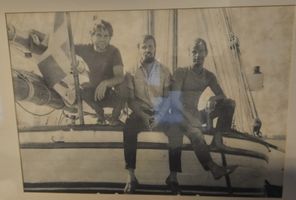
Kjelle Gustad, Arne Lindstrand and Hasse Broberg onboard "Pride of the Oceans".
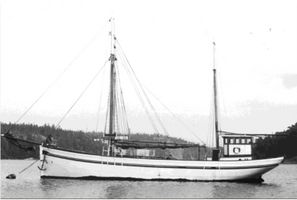
A photo of the boat.
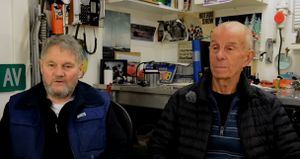
A photo of Kjelle and Hasse from the film "Pionjärerna" by Dan Nilsson.
.jpg)
.jpg)
.jpg)
1970s and Later
After some time in Florida, the boys returned home again. By then, they had received so many contacts and impressions from the United States that the trips became frequent. Cars were shipped home to Sweden, and they occasionally worked at boxing champion "Ingo" Johansson's hotel in Florida as a base in the 1970s.
As for most people, it was now time to start a family and prioritize other things in life. However, interest in motoring has always remained, and the contacts have never been broken despite being dispersed geographically. Thanks to meetings and activities over the years, people have met and talked about old memories. The next generation of talented Hot Rod and Custom builders takes over. Thanks to better regulations and easier access to parts, the hobby has grown since the 1980s.
The Enskedefältet scene is today regarded as one of the foundational environments of Swedish hot rodding, defined by collaboration, ingenuity, and a lasting cultural legacy. We owe much to these early pioneers who left behind a priceless legacy of inspiration and myth-making.
References


Did you enjoy this article?
Kustomrama is an encyclopedia dedicated to preserve, share and protect traditional hot rod and custom car history from all over the world.
- Help us keep history alive. For as little as 2.99 USD a month you can become a monthly supporter. Click here to learn more.
- Subscribe to our free newsletter and receive regular updates and stories from Kustomrama.
- Do you know someone who would enjoy this article? Click here to forward it.
Can you help us make this article better?
Please get in touch with us at mail@kustomrama.com if you have additional information or photos to share about Enskedefältet - One of the Birthplaces of Swedish Hot Rodding.
This article was made possible by:
SunTec Auto Glass - Auto Glass Services on Vintage and Classic Cars
Finding a replacement windshield, back or side glass can be a difficult task when restoring your vintage or custom classic car. It doesn't have to be though now with auto glass specialist companies like www.suntecautoglass.com. They can source OEM or OEM-equivalent glass for older makes/models; which will ensure a proper fit every time. Check them out for more details!
Do you want to see your company here? Click here for more info about how you can advertise your business on Kustomrama.